Opens in a new tab

Injection moulding for manufacturing & process engineering

Industries

Plastics keep processes moving

Manufacturing & process engineering
In manufacturing and process plants, engineering plastics perform key functions: they guide, slide, convey, dose, seal, and protect. They can reduce friction and moving mass, operate without external lubrication, and withstand aggressive media or intensive cleaning processes. The key is to consistently match the material and component to the load, medium, temperature, and production environment.
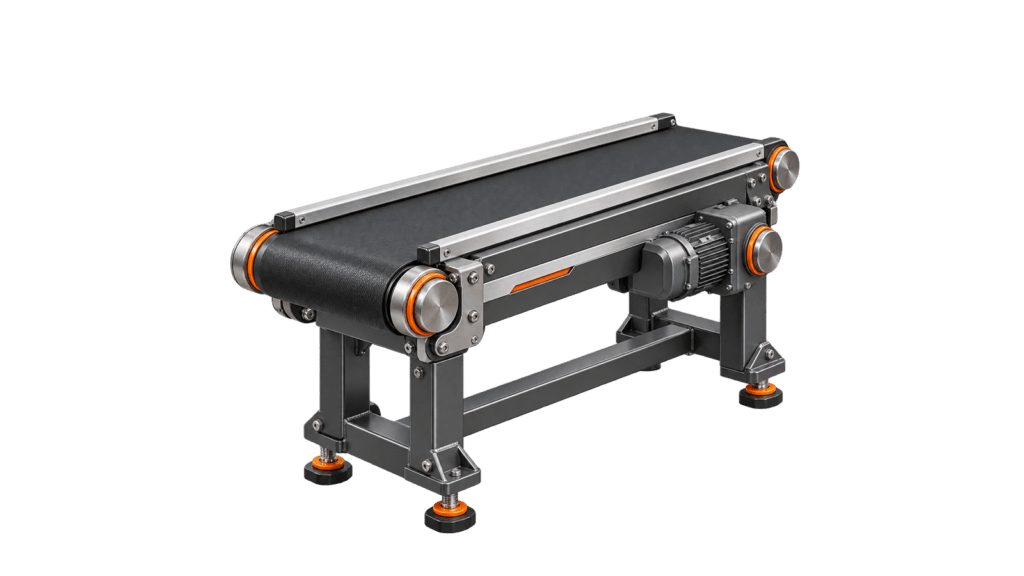
Conveyor belt as an example of plastic components in industrial production plants
up to 75%
lower coefficient of friction of a slide-optimised material compared with standard PE-UHMW, with POM as the mating material.
up to 80%
less weight compared with stainless-steel bearing solutions.
up to 260°C
Continuous use, using one PEEK grade as an example.
500/min
products per minute in a system with plastic guides.

When downtime is not an option

Development challenges
Manufacturing and process plants must operate precisely and reliably over long operating periods. Friction, wear, aggressive media, temperature, cleaning, and fluctuating loads act directly on every component. For product-contact components, hygiene, contamination protection, and regulatory requirements are added.

Wear & continuous operation

Guides, bearings, rollers, and sliding elements often run continuously. Wear must not have an uncontrolled impact on precision, process stability, and system availability.

Friction & lubrication

Friction affects drive power, heat build-up, and wear. At the same time, external lubrication may be undesirable in clean or product-adjacent processes.

Chemicals & process media

Acids, alkalis, solvents, cleaning chemicals, or process media can attack materials. Resistance must be verified for the medium, concentration, and temperature.

Temperature & cleaning

Hot water, steam, cleaning processes, and temperature changes stress both material and geometry. Temperature and hydrolysis resistance therefore become process requirements.

Precision & dimensional stability

Dosing, guiding, and sealing require reproducible geometries. Creep, moisture absorption, and thermal expansion must be considered over the actual service life.

Hygiene & product safety

Where there is product contact, material, surface, and component geometry must allow cleaning and minimise contamination risks. Depending on the application, additional regulatory requirements apply.

From process requirements to a production-like component

With rapid tooling, aluminium moulds, and injection moulding in the intended production material, real components for application-relevant testing can be produced quickly. This allows fit, movement, media contact, and function to be assessed early, and design adjustments to be implemented rapidly.
Check feasibility

Project communication made easier than ever

Easy collaboration
No forced tools. No unnecessary detours. No complicated coordination processes. We communicate with you in the way that is easiest for you and your team – via Teams, WhatsApp, email, or directly through procurement platforms such as SAP Ariba, JAGGAER, or Cegedim. Because in the end, what matters to us is not which channel we use, but that information reaches where it is needed quickly – so your project moves forward and you can hold your production-like prototype in your hands sooner.

You decide how we communicate

The best communication channel? The one that works for you.
Microsoft Teams
Direct coordination with your project team.
WhatsApp
Quickly clarify a question or exchange information.
Email
For anything that needs to be documented in the classic way.
Partner platforms
SAP Ariba, JAGGAER, Cegedim, and other established procurement systems.

The process behind it stays simple, too

We do not just want to manufacture quickly. We also want to make the path to the component as straightforward as possible.
Fast onboarding
So we can get started together without a long ramp-up phase.
Direct procurement processes
We integrate into your existing purchasing and procurement processes.
Less friction. More speed.
Clear communication and well-established workflows ensure decisions can be made faster.
Ready for a partnership without detours?
We make it as easy as possible for you to get started – in communication, procurement, and the entire project process.

Materials for continuous-operation processes

Material expertise for manufacturing & process engineering
In manufacturing and process plants, the material must match the function precisely. Friction and wear, process medium, temperature, cleaning, and dimensional accuracy are just as decisive for selection as hygiene or product-contact requirements. Engineering and high-performance plastics offer a broad range of properties for this.
Black plastic granulate as raw material for manufacturing injection-molded parts

Wear-resistant & low-friction

Controlled friction and high wear resistance support guides, bearings, rollers, and conveying components in continuous operation.

Dry running & low dependence on lubrication

Tribologically optimised plastics can enable sliding points without external lubrication – of interest for hard-to-access, clean, or product-adjacent applications.

Chemical & corrosion resistance

Process media, acids, alkalis, and cleaning chemicals require materials whose properties match the specific medium, concentration, and temperature.

Temperature & hydrolysis resistance

High process temperatures, hot water, steam, and temperature changes place special demands on mechanical properties and dimensional stability.

Dimensional accuracy & dimensional stability

Guides, dosing components, and sealing surfaces must reliably maintain their geometry under temperature, moisture, and continuous load.

Hygiene & detectability

In sensitive production areas, product contact, cleanability, and the detection of potential foreign bodies can place additional requirements on the material.

Material examples

POM · PET · PA · PP · PVDF · PFA · PPS · PEEK · PEI · PSU/PPSU · TPE/TPU · GF-/CF-reinforced and tribologically modified compounds.
Special requirements for your component?
Together, we will assess which material and which process best suit your application in manufacturing & process engineering.

Faster to a production-like component

Why priomold
When development time, costs, and meaningful results are critical, you need a partner who can respond quickly and flexibly. With rapid tooling, we combine short lead times with production-like injection-moulded parts – ideal for prototypes, testing, and small series.

Rapid tooling

Develop quickly and flexibly
Our aluminium moulds enable short tool lead times of between 2 and 8 weeks, depending on your priority, and fast adjustments during the development phase.

Prototypes from 5 days

When every week counts
For particularly urgent projects, initial injection-moulded prototypes can be produced within a week.

Production-like materials

Validate under realistic conditions
We manufacture components in the intended production material, allowing function, feel, dimensional accuracy, and material behaviour to be assessed realistically – far closer to series application than purely visual models.

FAQs on manufacturing & process engineering

Frequently Asked Questions
Answers on materials for wear, friction, process media, temperature, and continuous operation.

For guides, bearings, rollers, or sliding elements, friction and wear are key selection criteria. In addition, load, speed, mating material, temperature, and the specific operating environment must be taken into account.

Yes. Tribologically optimised plastics can enable sliding points without external lubrication in suitable applications. However, whether dry running is advisable depends on load, speed, mating material, temperature, and geometry.

Yes. We always assess resistance in relation to the specific process medium. Factors include concentration, temperature, exposure time, and mechanical load. On this basis, suitable materials can be selected for prototypes and production-like testing.

Depending on temperature and load, different engineering and high-performance plastics are available. In addition to continuous and peak temperatures, mechanical load, process media, and, where applicable, cleaning processes must also be considered.

We consider the material and component geometry together. Manufacturing tolerances, thermal expansion, moisture absorption, creep behaviour, and continuous load can affect later function. That is why we review critical areas for injection-moulding feasibility before toolmaking.

Most helpful are 3D data or drawings, as well as details on function, load, temperature, movement, process media, and the desired quantity. On this basis, we can evaluate material, component geometry, and tool concept, and support you in designing for injection moulding.

Haven’t found the right answer yet?
Just write to us — we will be happy to help you!
Freigestelltes Porträt von Tobias Camek, Leiter Kundenmanagement bei priomold
Any further questions about your process application?
Tobias will be happy to help if you have questions about material, medium, load, or the technical implementation of your component.
Tobias Camek
Head of Customer Management
Contact Tobias

Or email Tobias at t.camek@priomold.de

Quick response
Personal contact
Clear, straightforward answers